
EXCELLENCE FOR LEARNER ASSESSMENT
Since 2009, I have actively participated in the examination process at both undergraduate and postgraduate levels. I believe that teachers must be vigilant in understanding their students’ learning progress, because proper examination is a professional responsibility that goes beyond judging learners; it also serves as a self-evaluation tool for educators. Without evaluating student understanding, the effectiveness of teaching remains questionable (Angelo and Cross, 2012).
One of my students shared that an eminent professor in the USA acknowledged her knowledge and critical thinking ability by saying “… you had a wonderful teacher” to which she acknowledged me by replying “…yes indeed.
I encourage an open classroom environment where students feel safe to ask questions without fear of ridicule. I also involve peers in answering queries, fostering a collaborative and active learning atmosphere. I employ a combination of summative and formative assessments, ensuring the evaluation of students’ knowledge and skills in a structured manner (Dixson and Worrell, 2016). The assessments I use, including workplace-based assessments (WPBA), are designed to provide immediate feedback and guide learners on their strengths and areas of improvement. This competency-based approach helps students progress by receiving feedback that is timely, specific, and framed in the sandwich technique, which keeps them motivated and focused.
The rationale behind my approach is to maintain reliability and validity in assessments, reflecting continuous improvements in teaching strategies (Harlen and James, 1997). WPBA, in particular, allows for real-time feedback, facilitating learning through immediate application and self-reflection. I believe that effective assessment is not just about grading but about creating a supportive learning environment that encourages self-awareness and growth.
Student feedback and professional achievements reflect the positive impact of my approach. One of my former students shared how an eminent professor in the USA recognized her critical thinking skills, attributing them to the quality of her previous instruction, and acknowledged my role in her education. Such feedback highlights the broader impact of effective assessment and mentorship.
Initially, providing impactful feedback was challenging. I struggled with timing, detail, and engagement, often fearing that feedback might negatively affect students’ morale. To improve, I adopted various techniques, including the Sandwich Technique, SWOT analysis, and the GROW model. I also incorporated the One-Minute-Preceptor (OMP) tool, which has proven highly effective in our learning environment, enabling immediate and actionable feedback.
Recognising the evolving role of technology in education, I integrated online assessment tools like Quizizz (Evidence 1) to enhance active participation and identify specific areas of student difficulty (Marriott, 2008; Shrivastava, 2019). In one instance, an online quiz helped reveal a high-performing resident’s struggle with time pressure, highlighting her need for stress management and quick decision-making skills. This insight allowed me to provide tailored guidance and practice sessions, ultimately leading to her improvement.
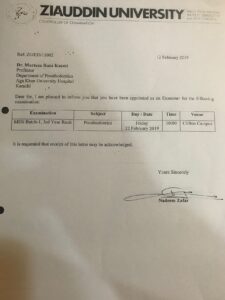
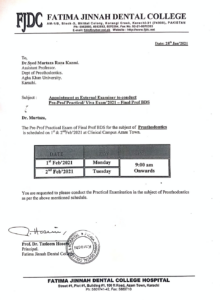
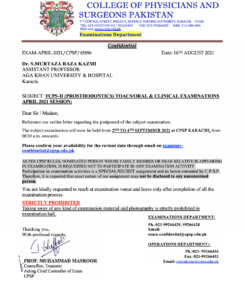
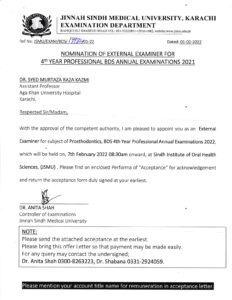
I have been actively involved in both undergraduate and post-graduate (Prosthodontics) for last fifteen years (Evidence 2).
Hamdard University since 2009.
University of Karachi since 2010.
Dow University of Health Sciences since 2010
Liaquat University of Medical & Health Sciences since 2010
Ziauddin University since 2015
Dow University of Health Sciences since 2010.
Liaquat University of Medical & Health Sciences since 2010
Ziauddin University since 2017
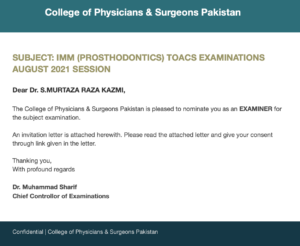
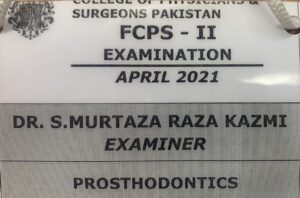
College of Physicians and Surgeons Pakistan, both for fellowship and membership since 2016.
Angelo TA, Cross KP. Classroom assessment techniques. Jossey Bass Wiley; 2012 Oct.
Dixson DD, Worrell FC. Formative and summative assessment in the classroom. Theory into practice. 2016 Apr 2;55(2):153-9.
Harlen W, James M Assessment and Learning: differences and relationships between formative and summative assessment, Assessment in Education: Principles, Policy & Practice. 1997;4:3,365-379, DOI: 10.1080/0969594970040304
Miller A, Archer J. Impact of workplace based assessment on doctors’ education and performance: a systematic review. Bmj. 2010 Sep 24;341.
Marriott P, Lau A. The use of on-line summative assessment in an undergraduate financial accounting course. Journal of Accounting Education. 2008 Jan 1;26(2):73-90.
Shrivastava SR, Shrivastava PS. Use of e-learning tools for assessment in medical education. Medical Journal of Dr. DY Patil University. 2019 May 1;12(3):284-5.